What is SMO?

What is SMO? or Social Media Optimization?

Social Media Optimization or SMO is not a tool but it is today’s internet culture. With the Social Media Optimization sites on internet, people have got a good platform to become more social, more interactive and more communicative. What is SMO? Social Media Optimization doesn’t only allow discovering and reading the content and information but also encourages you to share the knowledge what you have. It is no more a one-way process but is a two way communication..

What is SMO?
(You have to Watch this Great Video on Youtube Now!)

7 Things You Can Do Right Now to Boost Your Website Conversion Rate

7 Things You Can Do Right Now to Boost Your Website Conversion Rate

Think about it for a moment…

What are the reasons for creating, updating, and maintaining your business website?

On the top of that list should be one important goal – acquiring qualified leads and customers.

Because let’s be honest, if your business website fails to generate qualified leads and customers, it will have a negative effect on your success.

Not only do you need to build a great website, but you also need to constantly optimize the design, the content and the usability of your website in order to convert more of your visitors – and achieve more of your business targets.

When you consider that the average website conversion rate is 2.35%, every website could do with a boost to improve results.Search Conversion Rate Distribution for website conversion rate

In this blog post, I’ll be sharing 7 things you can start doing immediately to boost your website conversion rates.

Without further ado, let’s see how your business can capture more leads and customers through your website.

1. Track your conversion rates effectively

If you want to boost your website conversion rates, the first step is actually having the knowledge of your current conversion rates. That’s why you must put a system in place to track it effectively.

While tracking your conversion rates, you need to be tracking against your goals. What are your conversion goals? 5%? 100 sign-ups?

A popular tool you can use is Google Analytics. To see how well your landing pages are converting visitors, you can set a goal in Google Analytics to track actions that are considered conversions.

For instance, a conversion goal could be your ‘thank you’ page after a visitor signs up or makes a purchase:

Goal Description for website conversion rate

Once a user gets to that ‘thank you’ page, it means that they’ve taken an action that counts as a conversion – and you can add them to your funnel.

When you’re able to track conversions effectively, it becomes easier to implement new strategies and see their effect on your results.

2. Build quality landing pages

Let’s be clear about this – most of your conversions will be on landing pages. Whether you’re trying to capture qualified leads or make sales, you need to build quality landing pages that can convince a visitor to convert. The more landing pages you have, the better – so ideally, you need to constantly create new landing pages, as well as optimize them regularly for better results.

Now, the concept of a quality landing page is subjective. But most quality landing pages have some common traits. These include:

  • A simple and attractive headline
  • Clear copy showing the benefits your ideal audience wants
  • An obvious call to action button with words displaying your offer
  • Social proof such as testimonials, case studies, number of users, etc.
  • Visuals supporting your page offer

Apart from increasing the quality of your landing pages, you also need to increase their quantity. Because having more landing pages also means more opportunities for conversions.

And this is supported by a HubSpot study where companies increased their lead acquisition by 55% when they increased the number of their landing pages from 10 to 15.

Impact of Number of Landing Pages on Lead Generation for website conversion rate

To create quality landing pages, you need the right landing page builder. And, of course, the right landing page builder for you will depend on your needs.

If you use WordPress on your website, one of the best solutions is Elementor; one of the best parts is that you can use it to design your landing pages directly in your WordPress dashboard.

It provides a simple drag and drop builder to help you create your landing pages even with few (or no) design skills:

Donut Worry Landing Page Design for website conversion rate

You can also easily add forms, create pop-ups, ensure your landing pages are mobile-ready, amongst other features; plus, the fact that it’s built-in to WordPress makes it much easier to create new landing pages regularly, as needed.

3. Go for simple page designs

It’s hard to go wrong when you have a simple, easy to follow landing page. Whatever offer you’re trying to make to your audience, you need to do it in the simplest and clearest way possible.

A Google study found that visitors can form an impression of your page after viewing it for just 50ms. Pages with low visual complexity (VC) and high prototypicality (PT) appeal more to visitors.

Go for Simple designs for website conversion rate

Keep in mind that having some elements on your page will distract landing page visitors from converting – even though they might seem useful or they make your pages look better.

Two common examples are outbound links and navigation bars. These provide opportunities for visitors to leave your landing pages without performing your intended action.

Despite this, only 16% of landing pages are without a navigation bar. By removing navigation bars, AmeriFirst increased their landing page conversion rate by 40%.
AmeriFirst Landing Page Conversion for website conversion rate

See an example of a very simple landing page from QuickSprout:
Quicksprout for website conversion rate

It’s basically just a form; and the form only features the basic fields you’d need to get a lead’s information, plus a field asking about people’s marketing budget, which is quite useful for qualifying leads if your service is high-cost.

It’s not just links and navigation bars that you need to consider, but also the actual design; this too should be kept simple, with lots of white space and little content or visuals, as too much can overwhelm and confuse visitors.

4. Use lead magnets and content upgrades

Before visitors will release their personal information to you, they want to get some value for it. What value can you provide for your readers in return for their details?

A lead magnet is a piece of content that solves an immediate problem for your audience. Examples of lead magnets are:

  • eBooks
  • Whitepapers
  • Webinars
  • Checklists
  • Videos
  • Discounts

Content upgrades are a form of lead magnet that is more targeted. This means you’re trying to attract your audience with a piece of content that is highly relevant to the page they’re currently viewing; and that in turn means they’re more likely to convert.

See an example where Brian Dean offers a content upgrade on his popular Google ranking factors post:

Brian dean Offers Content Upgrade for website conversion rate

Amazingly, the content upgrade led to a 785.01% increase in conversions within a month.

Landing Page Goal Conversion Rate for website conversion rate

A tool you can use to deliver content upgrades to your page visitors is Optimonster. It also provides the option to deliver exit-intent pop-ups to visitors about to leave your page, plus you can use it to create pop-ups and forms, as well as track your analytics, easily:
Optinmonster for website conversion rate

5. Carry out A/B tests on web page elements

Since there’s no perfect landing page, A/B testing is an activity that you must engage in during your campaigns. As a matter of fact, testing should go on for as long as a page exists – you’ll keep learning what makes your visitors convert so that you can continue to boost your landing page conversions, time and time again.

Having said that, what are the page elements you have to test on your landing pages?

  • Headline
  • Page copy
  • CTA button color
  • Page background
  • Visuals

With these tests, you can optimize conversions for your page. To make your tests accurate, it’s vital that you only test a single page element at a time. This way, you’re able to pinpoint the changes responsible for your results.

A tool that can help you carry out effective A/B tests is Crazy Egg. It allows you to set the elements you want to test on your page and for how long.
Crazy Egg for website conversion rate

Added to this, you can see heat maps of your visitors’ activity and eye movement to see which regions of your page get more eyeballs. So, for example, you might notice that a lot of people aren’t looking at your call to action – in which case it’s imperative that you change the location or the colors used so that you can get more eyeballs on the call to action.

In a test, 160 Driving Academy tested a stock image against a unique image of their student in front of a truck. This simple test led to a 161% increase in conversions for the company:

160 Driving Company simple test increase 161 Percent in Conversions for website conversion rate

6. Use social proof to convince visitors

Your potential customers might be skeptical of your intentions when you market your product yourself. But they find it easier to believe your message when it’s coming from your satisfied customers.

After all, your customers have little or nothing to gain from marketing your products. Communicating social proof is a way of showing prospects that you’ve already provided the solution they’re looking for to other businesses and other customers just like them.

Some ways to demonstrate social proof, include:

  • Testimonials
  • Case studies
  • Number of sales made
  • Number of customers
  • Glowing customer reviews

Social proof allows a prospect to convince themselves that they can get the solutions they want from your service. See an example from Sumo where they featured Pat Flynn’s endorsement of their product.

Sumo for website conversion rate

7. Carry out competitive analysis

Every business has competitors. And it’s better to follow up on them before they run you out of business.

First of all, there are many things you can learn by spying on your competitors. A few elements of their website that you should study, are:

  • Design
  • Page copy
  • Offer
  • Product or service features
  • Social proof they use
  • Payment platforms they use
  • Call to action

A reality you need to face is that potential customers will go through different websites before they make their choice on where to buy. So how do you gain an edge on your competitors?

The first step is knowing your competitors and their strategies. The second is finding ways to gain an advantage over them – and build better, higher-performing landing pages.

A tool like Crayon uses artificial intelligence to monitor important competitor activities and provide valuable insights to help you follow up on their moves. With this, you can take more proactive actions on your pages and convert more visitors:

Crayon for website conversion rate

Conclusion

Increasing website conversion rates is a continuous activity for your business. Because converting more of your visitors means more customers and increased profits – which, after all, is almost any businesses’ main objective.

What are you doing to help increase your website conversions? What tactics are you using?

Guest author: Lilach Bullock is highly regarded on the world speaker circuit, Lilach has graced Forbes and Number 10 Downing Street. She’s a hugely connected and highly influential entrepreneur. Listed in Forbes as one of the top 20 women social media power influencers and was crowned the Social Influencer of Europe by Oracle. She is listed as the number one Influencer in the UK by Career Experts and is a recipient of a Global Women Champions Award for her outstanding contribution and leadership in business. Check out her site Lilach Bullock or connect with her on LinkedIn.

The post 7 Things You Can Do Right Now to Boost Your Website Conversion Rate appeared first on Jeffbullas's Blog.


source https://www.jeffbullas.com/website-conversion-rate/

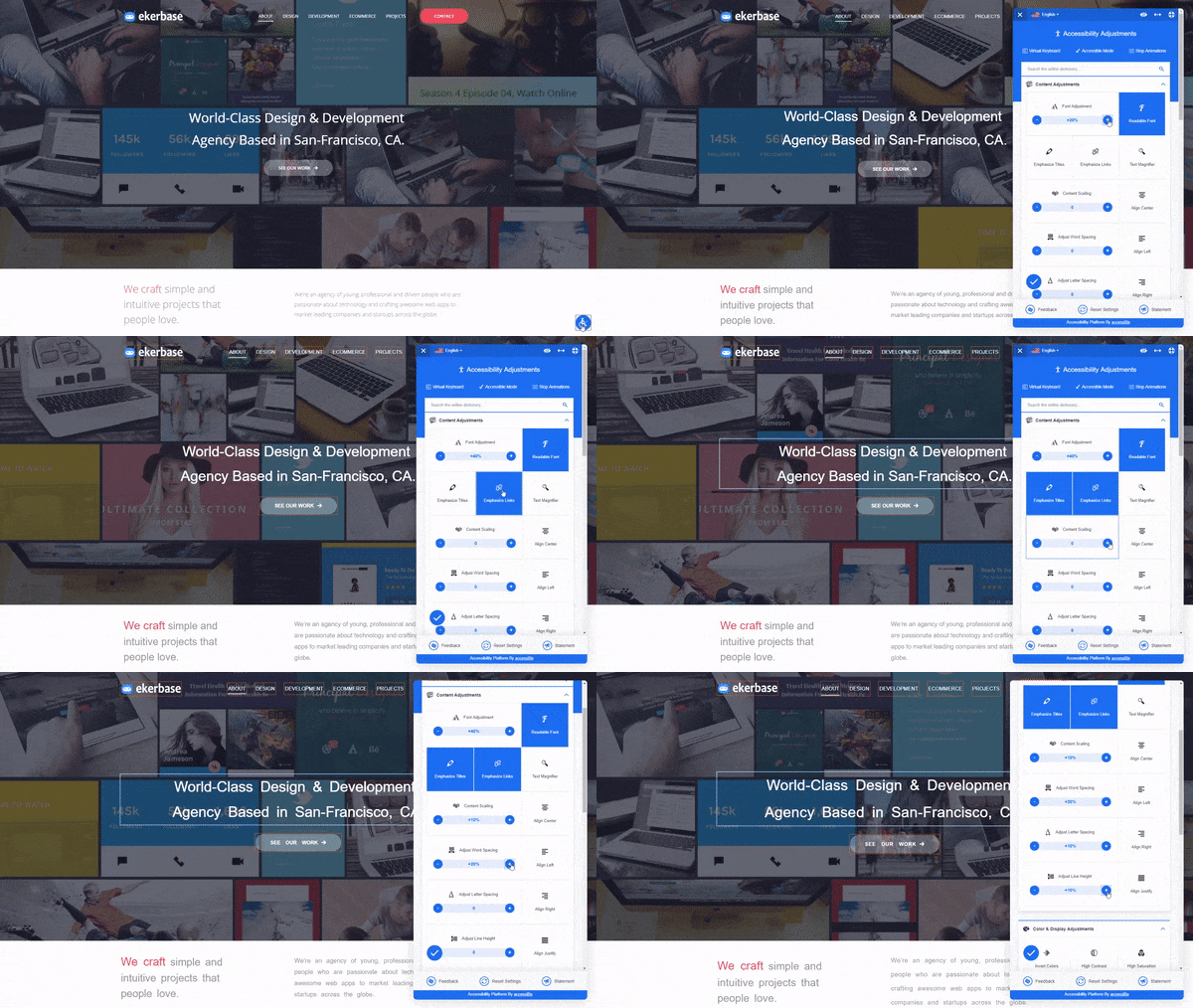
What Is Website Accessibility and Why Does It Matter?

What Is Website Accessibility and Why Does It Matter

In so many ways, the Internet has been the great equalizer. While it would have been almost impossible for the average person to reach an audience of millions in the past, the Internet grants a voice to anyone who can get online. Similarly, while it can take substantial investments in time and capital to open a more traditional brick-and-mortar business, just about anyone can start an online business in seconds with very little in initial startup cost. Launch a blog or open an online store, build your audience, gain their trust, and you can literally start making money today.

As impactful as the rise and democratization of the Internet has been for the general population, it’s hardly complete. The truth is that upwards of 25 percent of the western world’s population faces some challenges or hurdles in regards to website accessibility. With disabilities such as limited vision, hearing loss, motor dysfunction, seizure disorders and more, individuals with disabilities and other impairments may not be able to enjoy the full benefits of a website without help from another person, from technology, or from some combination of the two.

Site owners and online content creators, working alongside the web design industry as a whole, can do a lot in reducing these sorts of struggles and frustrations by offering fully accessible site designs that comply with officially accepted standards. In particular, the Americans with Disabilities Act (ADA) calls for compliance with WCAG (Web Content Accessibility Guidelines) and Section 508 as the benchmark for user-friendly design. For all users.

The WCAG Explained (Including WCAG 1.0, 2.0, 2.1)

The Americans with Disabilities Act first set out to provide better accessibility options in public physical spaces for individuals with physical disabilities. But this notion of “public space” has since expanded to include the Internet, as a “digital” public space, and as a result, the same philosophy applies: all individuals, regardless of disability, should still have equal and reasonable access to what the space (website, in this case) is meant to provide the general public.

And, in much the same spirit, the WCAG was born. It was developed and published by the Web Accessibility Initiative (WAI) of the World Wide Web Consortium (W3C), the latter of which operates as the primary organization overlooking international standards on the Internet. The objective with the WCAG is to outline a series of recommendations to make online content more accessible for both individuals with disabilities and the public at large, both on desktop and mobile.

This is not a new development; WCAG 1.0 was first published way back in May 1999. It has subsequently been updated to WCAG 2.0 in December 2008, and more recently with WCAG 2.1 in June 2018. The guiding principles are that web content should be perceivable, operable, understandable and robust. WCAG compliance is graded on three levels – A, AA, and AAA – and most legislation calls for at least AA compliance.
Overview of Compliance Levels for Website Accessibility

Image Source

Web design agencies must comply with ADA and WCAG standards

It’s true that a big part of the push toward designing and creating more accessible websites is an altruistic one; it only makes sense that you want your website to be reasonably accessible and usable by everyone. This also makes a lot of sense from a business perspective, because it means that you have a better opportunity to capture a broader audience and customer base; a website with poor accessibility makes for an unpleasant experience for individuals with disabilities, especially when dealing with eCommerce websites. But, there is more to this.

The growing prevalence of legal action taken against businesses whose websites don’t reasonably comply with ADA or WCAG standards is alarming. By offering and running a website that is not accessible and fully compliant with the aforementioned regulations, businesses leave themselves vulnerable to costly and potentially devastating lawsuits.

By extension, fewer and fewer businesses will be willing to work with web design agencies that do no commit to deliver WCAG 2.1 compliant websites.

It doesn’t matter if the agency you hire can create visually stunning websites if these designs are not accessible to your users. It’s reasonable to assume that due to the rising wave of web accessibility lawsuits, business owners will only turn to web design agencies that develop websites which are fully accessible and compliant with the ADA and WCAG 2.1.

Website accessibility is not a best practice, it’s mandatory. Complying with ADA and WCAG standards has effectively become law in many countries based on legislation and precedent, including the United States.

AI technology as the solution to website accessibility

What if I told you that you could achieve full ADA compliance in less than 48 hours? While designing a completely unique website from scratch can definitely take a lot longer than that, it is fully possible to configure your existing website design so that it aligns with the recommendations outlined in the WCAG 2.1. To achieve this, you’ll need to leverage artificial intelligence technology utilized by accessiBe, a company trusted by over 2,500 small to medium-sized businesses (SMBs) and industry leaders, including Burger King, BMW, and Avon.

Rather than rely on manual updates that can be very time-consuming and costly, since you’d need to keep hiring expensive accessibility experts to re-audit the site, the AI-powered solution from accessiBe is fully automatic. It can run every 24 hours too, so even on websites with frequent updates, you can be assured that you’re maintaining full WCAG compliance.

Artificial Intelligence is far more efficient and cost-effective than the manual approach, which can cost thousands of dollars in just an initial project without maintenance. With more businesses running their day to day operations online, using cloud technology, and moving towards automated and AI solutions, this is just another perfect example of a task that should be added to the list.

This is especially true when you take a moment to look at the many disabilities and impairments that your site, applications, tools, and business must be compliant with.

Example of Disabilities for Website Accessibility

Tips to make your site accessible and compliant

It’s true that the AI solution can achieve full accessibility in less than two days. At the same time, it’s a good idea to be very mindful of accessibility standards as outlined by WCAG as you consider how your online content is displayed, consumed, and used by users of all abilities. Some general tips and steps to keep in mind include the following:

  • Enable users suffering from epilepsy to disable all animations, videos, and GIFs with the click of a button, to browse your site safely without the risk of experiencing a seizure.
  • All non-text content must be accompanied by a text-based alternative to aid the visually impaired experience visual content.
  • The text alternative should be formatted in such a way that it can be converted to other forms, like braille or text-to-speech.
  • Ensure that the site design is not only responsive but that the content can retain the same effective structure even when scaled at higher levels.
  • Separate the foreground from the background clearly, paying attention to contrast ratios and color choices.
  • Offer fully functional site navigation that does not require touchscreen or mouse pointer-based interaction. Users should be able to get around easily using only a keyboard.
  • Avoid any deceptive or misleading design cues. Web pages should render and work in predictable ways.
  • Test to ensure all web content is correctly rendered and delivered across a variety of devices, screen resolutions, screen sizes, and device setting configurations.

Remember that website accessibility matters, both in principle and for your bottom line. You need an accessible website now more than ever.

Guest author: Zac Johnson is a world-renowned blogger and entrepreneur with nearly 20 years of experience in the online marketing space and has helped his readers generate millions of dollars online. He shares his story and guidance at ZacJohnson.com

The post What Is Website Accessibility and Why Does It Matter? appeared first on Jeffbullas's Blog.


source https://www.jeffbullas.com/website-accessibility/

5 Considerations For Choosing a Social Media Management App For Your Business

5 Considerations For Choosing a Social Media Management App For Your Business

Not that long ago, one of the best ways a business owner could get in front of consumers was to take out a small ad in the Yellow Pages. Potential customers “let their fingers do the walking” through the huge paper directory of businesses and would stumble upon yours. And if your business name started with an A, B, or C so that it was listed first? Even better.

But those days are gone, and – like it or not – your business needs to be everywhere consumers may be looking for you. Along with search engines, review sites, and industry-related directories, the big hitters are social media networks, including Facebook, Twitter, Instagram, Pinterest, YouTube, and LinkedIn.

In fact, the 2019 Social Media User Trends Report from GlobalWebIndex cites that 4 out of 10 consumers will use social networks to research a new brand or product. And for consumers age 16 to 24, social media is the top method for research, outweighing search engines since 2017.

All right, already – you get it: Social media is important (critical?) for your business. However, managing six different networks while trying to run your business can be difficult at best. So, it’s probably time to invest in a social media management app to help facilitate your social media while being your brand’s eyes and ears in the social realm.

To assist you in making the most educated choice, consider the following five statements and whether the tool you’re eyeing enables you to fulfill all of them.

1. Be everywhere

As previously mentioned, your business needs to be represented in all the places where your potential customers are. Make a list of all of the social networks and which ones drive the most leads to you. Maybe you’ve determined that Facebook and LinkedIn are the best sources for your company or that Instagram and Pinterest are your top performers.

Armed with this list, you’ll want to choose a social media management app that publishes to and tracks those networks. Not all tools publish to all networks, so you want to ensure that your top social networks are represented.

Keep in mind that you might need to sacrifice features for the ability to publish to your principal social networks and vice versa.

Hoosuite Social Networks for social media management app

Hootsuite integrates with the six biggest networks as well as publishes to WordPress.

2. Be responsive

When customers contact your company through social media, you must respond quickly. A quick and appropriate response is also needed when fans comment on and ask questions within your posts or ads, write Facebook reviews, and talk about your brand anywhere on social media.

An effective social media management app will enable you to track, monitor, and respond to all of these points of engagement (and then some) by:

Monitoring: From inside the app, monitoring lets you review and respond to all social network engagement, including comments and replies on posts, direct messages, tags of your brand on other users’ comments and posts, and comments on your social media ads. Ideally, the app will funnel this engagement into one place, grouped by social network, so that you can easily take action.

Listening: Not to be confused with monitoring, listening enables you to track and respond to mentions of your brand when it is not You want to know when someone’s talking about your business, don’t you? And when your website content is shared, the listening feature will pick up those posts too.]

Another use of the listening feature is when the products and services you offer are “hinted at” on social media. For example, if you’re a plumber, you might listen on Twitter for phrases and hashtags like “leaky faucet,” “#BurstPipe,” or “water heater” in your service area. When appropriate, respond and offer your services or provide a blog post from your website with helpful information. Don’t worry about looking like a creeper, because everything in the Twittersphere is public.

Be responsive like wendys post for social media management app

Wendy’s has become quite famous for the fast-food chain’s fun, sometimes snarky, and very responsive Twitter feed. In this case, Wendy’s Tweeted a deal on Frosty at 4:46 pm. A “disgruntled” patron replied at 6:15 pm. Wendy’s responded the next day at 7:10 am with a solution. Can your social media management app help you be as responsive? It should.

3. Be effective

If a tree falls in the woods when no one is around to see it, does it make a sound? Similarly, if you publish a post about your anniversary party on three different social networks and no one sees it, does it have an impact? The answer to the latter is a resounding no.

For social media to be effective, you need to reach your audience at the right time and with the right message for the medium.

In other words, your social media management app should provide the reporting and analytics that enable you to make smarter decisions. What’s the best day to post, and what’s the best time of day? When are your followers most active on each network? And what types of posts are better for each network?

Not only are the analytics important, but so is having the reports in a format that works for you. Considerations for reporting include downloadable reports; post-level statistics; reports in PPT, PDF, and/or CSV; hashtag reports; and engagement reports. Determine what kind of reporting you need and ensure your tool can provide it.

In addition, if your business is a global brand, another consideration for your tool becomes the ability to post content depending on your followers’ time zones. The goal with this kind of data is to enable you to make more strategic decisions with your publishing, so choose a social media management app that helps you be more effective.

Agora Pulse for being effective for social media management app

Agorapulse provides a report on Facebook that details fan growth and the number of posts published in addition to the best day, best time, and the best type of post to publish. This type of information enables you to get better and better at posting effective and engaging content.

4. Be consistent

In the world of advertising, the general rule is that customers need to see an ad seven times before they purchase. The idea is that a consistent message tends to work. Translate that to social media – frequent, consistent posting of content will keep you top of mind for current and potential customers.

A good social media management app will enable consistent posting on your behalf with

Repeat Posts: If your tool has a repeat option, it will duplicate a post again in the future, either at a date/time that you schedule or after a certain amount of time has passed. Note: some social networks (ex. Twitter) don’t allow for repeated posts.

Queuing Content: With a queue feature, your tool lets you choose specific days and times to publish posts. (You determine these with the great analytics that your tool provides, of course.) Then, you provide content to be published, and the tool fills up your queue.

Curation: The above features publish your original, evergreen content, including blog posts, general branding, education, service offerings, and the like. But creating all that content can be time-consuming for a small business. With a content curation feature, your tool can help you find relevant content from other sources to share with your following. You simply review and schedule it.

Be Consistent like eClincher for social media management app

eClincher provides content curation from a variety of sources, including RSS feeds, Feedly, Pocket, and general news archives based on keywords.

5. Be savvy

Most people wouldn’t buy a car without taking it for a test drive. The same should be true for any tool that you purchase. Almost every social media management app comes with a free trial – some for as long as 30 days. Take advantage of free trials to explore tools’ functionality, reporting, and all its bells and whistles.

Find out whether the tool integrates into other software that your company currently uses. And, if applicable, check out the team collaboration aspect of any tool to ensure that it fits your needs.

You know your business better than anyone else, and that includes your financial capabilities and constraints. You don’t want to break the bank but make smart choices in investing in a tool. (Cheaper isn’t always better.) Truly analyze the ROI of purchasing this type of tool.

Take into account the amount of time you and/or your staff spend publishing content to multiple sources, compiling data from multiple sources, curating content to share, reviewing and responding to engagement on multiple sources, and so on. And don’t forget to account for the overall improvement that the tool will bring to your company, through quicker response times, optimized posts that drive more engagement, and increased awareness and reach.

Be Savvy like MavSocial for social media management app

MavSocial provides four plan levels, each building upon the other in terms of the number of social profiles, social networks, users, and more. All plans come with a free 14-day trial.

Wrapping up

Choosing a social media management app is no small feat. Social media consultant Ian Anderson Gray has published a comprehensive Buyer’s Guide to help professionals like you make the best choice for your company. It includes a handy side-by-side comparison of 13 tools on roughly 70 different features. This free guide will lead you to the tools that provide them.

Guest author: Andi Lucas is the founder and owner of Hummingbird Marketing Services, a boutique marketing firm based in Seattle and serving clients around the globe. Andi has almost 25 years of marketing, editing/writing, and overall business experience.

The post 5 Considerations For Choosing a Social Media Management App For Your Business appeared first on Jeffbullas's Blog.


source https://www.jeffbullas.com/choosing-a-social-media-management-app/

What Nourishes Your Soul?

What Nourishes Your Soul

Do you ever get to the end of the day and feel empty?

It’s a gnawing feeling.

Faint.

A whisper.

You have been busy and you have done all the things that society and family demands.

Kept your end of the bargain.

Been responsible.

Looked after the essentials.

Done the paperwork.

Gone to work.

It should be enough.

But deep down the happiness and joy is hiding.

But the reality?

You haven’t taken a step towards what fulfills you deep down.

And on reflection it means that if you keep driving into a life full of meaningless busyness you will have been dragged into trivia.

The superficial.

Some people call that life.

It’s existence.

Surviving.

Urgent but not important.

Obligatory.

Demanded and responsible.

So what nourishes you?

What makes you happy?

It is a simple question but it has some big answers that will change your life.

Forever.

If you take the time to reflect.

And manic busyness can block and stop that vital time of stillness.

But if you give yourself the permission to stop.

You will discover that the powerful human creator that sits in the corner of all our souls needs space and time to be.

You.

Without feeling guilty.

Family, friends and partners will get in the way.

They mean well.

But your responsibility?

If you want to grow and change your place in the world and make a difference.

Is to to make sure that you don’t die inside while everyone else demands your attention.

While not leaving the people and things that matter behind.

What works for me?

It is sacred space and place.

A home.

Safe and secure.

A corner that is yours and a dedicated time that is not up for negotiation.

It could be late.

Early.

From the outside it looks selfish.

But if you don’t put a stake in the ground for “you”.

Create habits that serve your soul.

You will lose your soul to other people’s demands.

You will be a hostage to meeting other people’s goals.

You will feel lost.

And at the end of your life you will be angry.

You will feel regret.

Bitter.

What do I need?

It’s not complex.

But it has taken a lifetime to discover.

It is about making time to be the master of my own destiny.

I need time to exercise. Leap on a bike and make the heart pump and the lungs scream.

I need time to read. To be inspired by the geniuses and makers that have gone before.

I need time to create. Writing,  reflection and digging deep into the feelings and words that communicate what it means to be fully human.

I need time to be still. To pause and stop the minds endless chatter. Feel my breath. Hear my heart. Meditate.

I need time with special friends.  Listen to their stories and life experiences. Hear their pain. Listen to their challenges. Feel their joy. Love them.

I need time  to watch a sunset. Watch the breeze ripple over the water. The cockatoos raucous call. Smell spring in the passing gardens.

I need time to make the morning coffee. Inhale the smell and essence of the coffee as I sit at my desk or nestle in the corner of a cafe.

The result?

Joy rises.

Wraps me in comfort.

Touches my heart and makes me sing.

How do you achieve this?

Give yourself permission.

Love yourself.

Then it comes down to routine and self mastery.

But the price of personal freedom is a paradox and enigma.

The truly free individual is free only to the extent of his own self mastery. While those who will not govern themselves are condemned to find masters to govern over them” – Socrates

And then there is the strength to say “No”.

To other people’s demands on your time.

Are you ready for that?

To be the true and extraordinary human that we all want and can be.

It’s time to realise your greatness.

Time to fly.

The post What Nourishes Your Soul? appeared first on Jeffbullas's Blog.


source https://www.jeffbullas.com/what-nourishes-your-soul/