What is SMO?

What is SMO? or Social Media Optimization?

Social Media Optimization or SMO is not a tool but it is today’s internet culture. With the Social Media Optimization sites on internet, people have got a good platform to become more social, more interactive and more communicative. What is SMO? Social Media Optimization doesn’t only allow discovering and reading the content and information but also encourages you to share the knowledge what you have. It is no more a one-way process but is a two way communication..

What is SMO?
(You have to Watch this Great Video on Youtube Now!)

Voice Search Optimization – A Beginner’s Guide For 2021

Voice Search Optimization – A Beginner’s Guide For 2021

Voice search isn’t a fad. It has been gaining popularity, and people are using it a lot more than ever before.

One of the main reasons for the trend is the high convenience for the user when they just have to talk with the assistant instead of typing. Also, when it comes to the results, voice queries are faster.

Let’s look at some voice search stats

Here are some interesting statistics that will make you believe that voice search will be here for years:

#1. Voice labs found that there are 33 million devices with voice-first that stay in circulation.

Voice-First-Device-Footprint

In the survey that was done in 2017, voice search was seen to be third in the ranking.

#2. eMarketer says, that 32.2% of the USA population use voice assistants monthly.

US-Voice-Search

#3. Google announced that 27% of queries are done through Google voice search.

27-The-Global-Online-Population

It was observed that teenagers had been especially savvy on voice search, but people from all age groups did use voice assistants at some point in time.

Top strategies for voice search optimization

People often use voice searches in their daily routine. With the increasing usage of digital assistants, there is a need for voice search optimization as well. Let’s look at ways you can optimize your website and its content for voice search.

At its core, working on optimizing for voice search does have similarities to SEO. But the focus has been refined. Here are some key factors that you can work on:

#1. Understand Customer Types and General Device Behavior

Voice searches also have algorithms that make use of location, as well as other data points. All of this is done for understanding the search context and marketers need to constantly work on a better understanding of consumer behavior.

Real-time data of consumer activity will help you understand the way people make use of voice search and the kind of devices they use.

#2. Conversational Keywords Need Your Focus

How people search using voice search:

  1. Longtail keywords
  2. Conversational tone

Let me explain this.

Generally, when people search for something, they use three to four words. On the other hand, voice searches are significantly longer than normal.

For instance…

When you type, you use computer language – “Best Chinese Restaurant”.

Google

But when you speak, you will be using a conversational tone like “what is the best Chinese restaurant near my location with no waiting time”, which makes both searches different.

Chinese-Restaurants-Area

In fact, according to Google, 70% of voice searches are in a natural or conversational tone.

While there is a low chance that keywords that are short will be completely disappearing, there is a possibility that the relevance will be reduced.

This is going to be mainly true as voice searches consider natural conversational phrases. Therefore, it will be vital that you work on the questions that need a complete answer so you can get more traffic to your website.

As people are switching towards voice search, the value of longtail keywords is increasing.
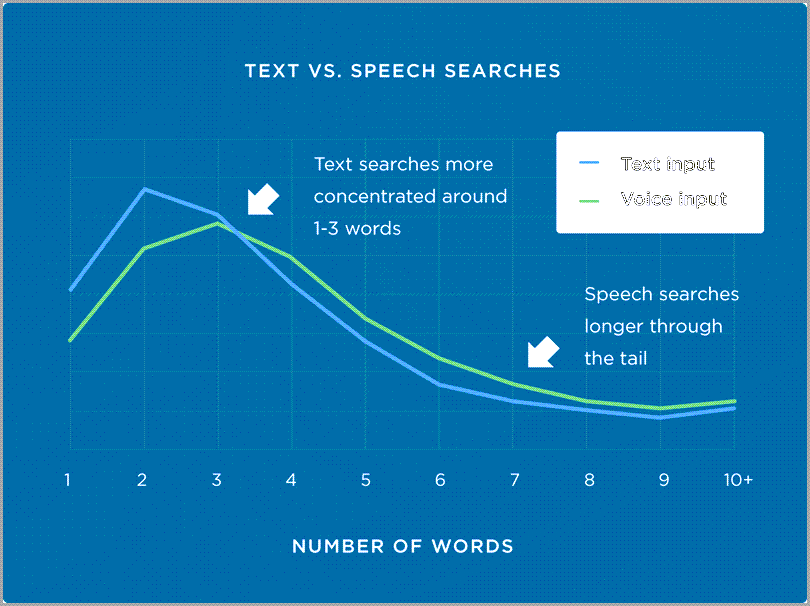
Text-VS-Speech-Searches

Image Source

As a result, don’t stick with 2 or 3 word keywords like “Chinese Restaurant” or “Best Chinese Restaurant“. Use longtail keywords in your content as follows:

Keyboard-By-Relevance

Also, I would suggest not re-creating all your content but inserting longtail keywords (no keyword stuffing) with a conversational tone.

#3. Content Creation Based on Personas

Relevance, context, and brevity will be essential when you optimize content for voice searches. But here will be a slight difference from general SEO strategies, and you can pay special attention to the following points:

  1. Create very detailed answers for common questions.
  2. Answer simple questions concisely and with clarity.
  3. Create compelling, rich content that will answer common questions that users have.

A lot of websites have been already adapting the following strategy, and you can follow it as well:

  • Create a web page or content with the headline that includes these common questions.
  • Just after your headline, offer a precise answer, and this can also be a definition for the specific question.
  • Make use of the page to offer detailed and relevant information on the topic.

One important thing that you need to understand with this strategy is making use of a robust webpage will ultimately lead to a higher ranking on Google. The simple and short information that you offer on the page gets optimized for voice searches and can even be featured as a snippet.

#4. Context and Schema Markup Should Go Together

Google understands languages by making use of schemas, and this can be the best way for adding detailed information to your website. You will also be ready for answering the questions.

It’s not a piece of cake to appear in a voice search because it shows only one result. You have to be well acquainted with schema markup.

In this regard, a schema markup has been introduced, which is “Speakable” (beta version). Currently, it is only available for news-related articles, exclusively servicing the US for now.

Sooner or later, it will be available for all.

#5. FAQ’s Have to Be a Part of Pages

When a voice searcher asks questions, usually there are words starting with “What”, “Who”, “When”, “How”, “Where”, and “Why”.

Hence, it is vital to add a FAQ section to your content.

People search for answers that should be fulfilling an immediate need.

Hence, make sure that there is an FAQ section included in your content. The answers should also be in a conversational tone that appeals to voice searches.

Even search queries starting with “What”, “Who”, “When”, “How”, “Where”, and “Why” are increasing.

Growth-Question-Phrase-Year-Over-Year

Google says, 2.68% of voice search results are an FAQ.

When I searched on “Bing Cortana” about “will a non-fault accident effect my insurance”, I got results as follow.

Open-Results-In-Browser

Surely, the answer was pulled from a FAQ page.

Zebra-Ask-An-Agent

Now, if you do not know which type of questions people are asking, then you can check out websites like Quora, Answer The Public, and Forums.

#6. Optimization of Voice Search Moving Ahead

A lot of people that have grown up in the era where technology wasn’t able to talk back still have a stigma attached while they speak to their phones.

Whereas the younger generation doesn’t have this hesitation, and when they make use of voice search, they feel more tech-savvy. Voice search remains on the rise, and not including it in your SEO strategy will be a foolish act. So, make sure that you include some of the tips mentioned above and move ahead with improving your business growth.

Case Study – Voice Search: What is the best way to peel pomegranate?

After searching, “what is the best way to peel Pomegranate?” I found bbcgoodfood.com in the first place.

Good-Food

Not like traditional search results, Google has read all points by saying, “Here’s information from BBC Good Food:“

Now, the question is, what factors helped this webpage rank higher on Google?

First of all, BBC Good Food is a high domain rating website. According to Ahrefs, it has 86 DR.

Domain-Rating-For-Bbcgoodfood-Com

Secondly, this page has 170 inbound links from authoritative websites.

Overview

Last, they have created their content point to point, which means nothing except “how to peel Pomegranate.”

How-To-Remove-Pomegranate-Seeds-BBC-Good-Food

Hence, this is how this page ranked on Google for voice search.

Guest author: Ravi is the co-founder of XplorMedia, a digital marketing company and head editor at WebHostingReviewsX. He has been making a living exclusively online since 2015. During his free time, he is a reader and game lover. Ravi writes on topics like Digital Marketing, AI, Web Hosting and other technical niches.

The post Voice Search Optimization – A Beginner’s Guide For 2021 appeared first on Jeffbullas's Blog.


source https://www.jeffbullas.com/voice-search-optimization/

The 3 Skills You Need to Truly Take a Brand Global

The 3 Skills You Need to Truly Take a Brand Global

Back in 1943, a 17-year-old boy Ingvar from Sweden opened a small business. The selection of products was very random – pens, wallets, watches, picture frames, and nylon stockings. Everything that people needed Ingvar sold at reduced prices.

Eight years later, the young business owner saw an opportunity to sell furniture. Of course, the competition got fiercer – it was still the post-war time, and people needed cheap but good-quality furniture for their homes. The only problem was that they couldn’t touch the furniture before ordering it.

Ingvar listened to the needs of people and opened the first physical furniture shop. Now, this business is known for its signature showrooms, where people can literally sit or lie down and check the furniture’s quality. We are talking, of course, about IKEA.

Today, you know IKEA as one of the most successful businesses worldwide, and it’s hard to believe that one time it was just a small venture. But thanks to Ingvar Kamprad’s skill to listen to people’s needs, IKEA went global.

This story makes me wonder – what other skills do you need to introduce your business to the international market and successfully conquer it?

Let’s take a look.

1. Smart risk-taking

Going global with your business is already a huge risk. So, either you should really know what you’re doing, or you just love taking risks.

Or both of these things at once.

Yes, there is such thing as smart risk-taking. And Shell’s history of global expansion proves it.

When in 1833, Marcus Samuel, the founder of Shell, learned about oil reserves in Azerbaijan, he immediately saw a chance to grow his business. He wanted his business to become something bigger – and the opportunity presented itself.

However, there was one obstacle – if dominant oil distributors like Rockefeller learned about his endeavors, he would fail without a doubt.

At that point, Marcus Samuel took the risk and shipped oil in bulk via the Suez Canal, which wasn’t used for this purpose at that time. Such a decision made a revolution in the oil industry, and Marcus Samuel eventually took Shell to the global market.

What’s the lesson here?

  • Smart risk-taking can help your brand go global. Marcus Samuel definitely took the risk, but it was also a very calculated move since he had to know the oil market from within.
  • Risk–taking spurs creativity. With his decision to tap into the oil market, Marcus Samuel had everything on the line. This inspired him to find creative way-outs.
  • As a risk-taker, you break free from the ‘average’. Smart risk-taking helped Marcus Samuel break old standards and introduce new solutions, which made him an innovator in the industry.

So, if you feel that it’s time to take the risk of going global, listen to your instincts. But, at the same time, prepare the safety bag and study the target market thoroughly.

2. Cross-cultural competency

Every business owner would admit that going global is a lot of stress. You need to take so many things into account – budget, marketing, shipping, etc. It’s too easy to lose sight of something.

But there are some things that businesses simply neglect when going international. There’s an old English expression – come rain or shine, which perfectly describes the attitude of such businesses towards some aspects of international expansion.

Cross-cultural competency is one of these aspects.

There have been so many cases of businesses harming their own authority just because they didn’t take the target culture into account. Take KFC’s fiasco in China, for example.

When the company was entering the Chinese market, naturally, it had to translate all its marketing materials into Chinese, including KFC’s slogan Finger-Lickin’ Good.

The translation of this slogan soon became one of the most laughed-at advertisements of all time – Eat Your Fingers Off.

As funny as it may be now, such a failure significantly damaged KFC’s reputation back then. And even though the company still entered the Chinese market, people couldn’t forget this fiasco for a long time.

What can we learn from KFC’s example?

  • It’s never a bad idea to invest in a translator. Even better – to invest in a native-speaker who knows the language and culture from within.
  • Always study how culture impacts the market. Every culture always has a system of taboos. Make sure you are aware of them before you make any attempts at marketing your business in the new market.
  • Think like your target audience. Take some time and learn your new audience’s behavior patterns. It will help you better understand what would make them buy your product.

So, no matter how good of an entrepreneur you are, if you stay blind to the traditions and customs of the foreign culture, you might regret it later. Besides, the foreign audience will quickly uncover your ignorance, so even the biggest budgets in the world won’t save you.  

3. Strategic business growth

Oftentimes, going global means acquiring or merging with other businesses. This is called strategic business growth, and it is one of the key skills you need to take your brand global.

One of the most popular examples of a brand going international through strategic business growth is Nestle.

Since 1905 and until today, Nestle keeps merging with more and more companies. The process started with Anglo-Swiss Condensed Milk Company, then it was a German brand Jopa, French chocolate manufacturer Heudebert-Gervais, and so on.

Today, Nestle still keeps merging with new companies and growing their produce. Strategic business growth helped it become one of the top 10 corporations worldwide and maintain its high position.

How do you approach strategic business growth in a smart way?

  • Choose businesses that share your values. A merger with another business should strengthen your values and authority, not make people question them.
  • Study their relationships with consumers. Otherwise, you might end up being a part of some controversy against your will.
  • Determine their attitude towards innovation. Nestle’s first merger with Anglo-Swiss Condensed Milk Company happened because the latter pushed hard towards developing technologies that businesses needed at that time. Today, the situation hasn’t changed, and your attitude towards innovation defines your future success.

As you can see, even though strategic business growth via mergers can be a good idea, there are a lot of hidden obstacles.

What’s the solution here?

Be open-minded but remain true to your business’s values.

Wrapping up

Taking your brand global is a rocky road. If you are not prepared for it, you’ll end up stumbling on every single pebble.

So, make sure you equip yourself not only with knowledge but with essential skills as well. Learn how to take smart risks, acquire cross-cultural competencies, and develop the skill of strategic planning.

Is this enough to take your brand global?

Of course not, because there’s always a bit of luck involved. But these skills will help you remain goal-oriented even in the most difficult times.

Guest author: Ryan is a passionate writer who likes sharing his thoughts and experience with the readers. Currently, he works as a digital marketing specialist at Preply.com. He likes everything related to traveling and new countries.

The post The 3 Skills You Need to Truly Take a Brand Global appeared first on Jeffbullas's Blog.


source https://www.jeffbullas.com/take-a-brand-global/

How Executives are Adapting to a New World of Constant Change

How Executives are Adapting to a New World of Constant Change

Being in the C-Suite is high pressure in 2021…

In fact, two-thirds of executives believe that the recent world events, and the aftermath, will be the most challenging time in their career.

Expectations from stakeholders are higher than ever. The workforce is mobile and global. Many young executives are underqualified for dealing with the complexities of a new world.

Frankly, not many people are equipped to deal with disruption and constant change. We’ve grown up with stability and structure. That’s what we crave.

But the business world is offering up something quite different.

The world events of 2020 are a sign of things to come. The future is about readiness, innovation, and acceptance of a new normal. Fortune will favor the brave, lethargy will destroy the weak.

The modern executive needs to be comfortable with the pain of constant change or they’ll die a slow corporate death.

Want to learn how the modern CFO is taking a more strategic role in business? Get this FREE whitepaper from Netsuite.

Focus on soft skills

The Brandon Hall Group reports that 77% of organizations are currently experiencing a leadership skills gap.

Despite being flush with smart, qualified, and technically brilliant individuals, they lack soft skills.

This is only amplified as we continue to work remotely and technology drives every interaction. Person-to-person engagements are few and far between. We need leaders more than ever to take charge and motivate their teams.

The encouraging thing about true leadership is that it’s a skill, not a talent. It requires discipline, learning, and repetitive application to reach mastery, just like any other skill.

Unfortunately, our corporations are built as hierarchies where the longest-serving people are rewarded with leadership roles. Not because of their ability to communicate, motivate, inspire, or challenge others in the organization. But purely because of tenure.

If executives want to embrace a new world and navigate a constantly changing ecosystem they need to refine their soft skills and start breaking down this leadership skills gap. Take courses, get involved in extra-curricular activities or community initiatives, enlist a mentor – buck the trend, and take charge of your leadership capabilities.

Be fearless with new technology

Technology is an accelerant to change. Deloitte’s Global Human Capital Trends report found that new technologies are the primary factor driving organizational change:

New-Technologies-Peace-Of-Change

While the global pandemic triggered a huge shift in the way we work, it also forced immediate innovation from corporations and executives to adopt new technology.

The modern executive not only needs advanced soft skills but they are also required to be at the forefront of technological advances. This means being not only aware of new technologies but also having a team that can innovate and apply those technologies to improve business processes.

“Prioritizing innovation today is the key to unlocking postcrisis growth” – McKinsey

In short – methodical and regular innovation is where the new normal begins and how we deal with a world of constant change.

An example of a new technology being used by CFOs to streamline financial processes is blockchain.

“Blockchain is a system of recording information in a way that makes it difficult or impossible to change, hack, or cheat the system.” (Source)

When it comes to financing and accounting records, blockchain provides a single source of truth for CFOs, including increased accuracy, quicker settlement times, and eliminates the need for reconciliations.

Basically, blockchain makes accounting faster, more accurate, and less susceptible to security breaches. A game-changer for CFOs.      

NetSuite is an example of this technology in action. It automates revenue forecasting, reclassification, and auditing through a rule-based framework.

Oracle-NetSuite-My-Top-Priority-Now

This is just one example of how executives are embracing new technology to create efficiencies and readiness for a complex economic environment.

Want to learn how the modern CFO is taking a more strategic role in business? Get this FREE whitepaper from Netsuite.

It’s time to embrace constant change

Only one thing is certain in today’s business world – change is constant.

If you take your eyes off the ball for a moment, the world could pass you by. Technology, trends, and world events trigger change and the best executives lead their organizations by embracing the uncomfortable.

A common misconception is that innovation and change are driven by the product team. In fact, all departments need to be ready for uncertainty and new opportunities.

Finance, for example, can be a catalyst for innovation. The blockchain technology example I provided above is just scratching the surface. Consolidation and optimization of financial processes can generate cost efficiencies that benefit further innovation in other areas of the business.

Essentially, innovation could come from the place you least expect it. To lead in a world of constant change, you need to create a culture of innovation that looks in every corner of the organization for opportunities.

Are you ready?

Join over 24,000 customers worldwide who use Netsuite’s accounting software.

The post How Executives are Adapting to a New World of Constant Change appeared first on Jeffbullas's Blog.


source https://www.jeffbullas.com/businesses-adapting-to-change/

7 Ways Video Conferencing Can Fuel Small Business Growth

7 Ways Video Conferencing Can Fuel Small Business Growth

Gone are the days when meetings were confined to conference rooms and offices.

In the modern digital era, video conferencing has changed the entire scenario.

Though video conferencing is not new for businesses, it gained traction after the outbreak of Coronavirus in 2020. Covid-19 forced global business professionals to collaborate and communicate with each other while staying at home. This was when video conferencing platforms stepped in as a boon breaking all the distance and geographical barriers and entirely changing the way people connect.

Undoubtedly, messaging and emails are important tools for regular business communication, but when it comes to dealing with clients, video conferencing presents countless opportunities to generate leads and close more sales in a cost-effective and efficient manner.

Further, video conferences help businesses gain a competitive advantage and strengthen relationships with prospects.

Wondering what more this collaboration technology could bring to your business? Let’s take a look.

Video conferencing – The perfect collaboration tool for small businesses

Video conferencing platforms are equally beneficial for businesses of all industries, be it healthcare, education, B2C, B2B, etc.

The increasing focus of small businesses towards video conferencing is evident from the following facts, which are taken from different sources, Gartner, Forbes, and Commercial Integrator.

Data-Is-Presented-In-An-Infographic
Presented-In-An-Infographic-Attached-In-The-Folder

Increase in downloads of select video conferencing apps as of March 2020 vs. weekly average for Q4 2019 (by country)

Pesented-In-The-Table-Infographic

Source: Statista

Benefits of video conferencing for small businesses

Below are some advantages of leveraging video conferencing for your next meeting or webinar.

#1. Reduce the carbon footprint

As video conferencing is replacing traditional face-to-face business meetings, you need not take a flight to travel to other cities, which considerably reduces carbon emission and ozone layer depletion. In a nutshell, video meetings are an eco-friendly business solution to contribute towards a greener planet.

#2. Enable a digital workforce

By adopting video conferencing, you encourage your workforce to become digitally competent. You can make real human connections even if the customer/client is not located in your city/country. Nowadays, there are various AI-enabled video conferencing software with advanced features, such as voice-controlled meeting management and automatic transcripts, which have entirely transformed the meeting experience.

#3. Streamline collaboration

Video conferencing has eased the collaboration with remote teams and clients, anywhere and anytime. You can edit documents, share your screen, provide feedback, and answer queries in real-time, thereby keeping the entire team in sync, eliminating their doubts, and increasing productivity. Moreover, team members can join video calls while on the go from their preferred devices.

#4. Secure business communication

Video conferences provide a secure and fast way to interact with several people at the same time. As cloud-based video conferencing platforms support Transport Layer Security (TLS) and Advanced Encryption Standard (AES), you can rely on them for secure business communication.

#5. Add an extra dimension to communication

In addition to text and voice, video conferencing lets you add visual elements to your meeting and engage viewers in a meaningful manner. Further, you can make your conversation more gripping and make a lasting impression by using apt body language. So, complement your words with the right vocal pitch, posture, facial expressions, and eye contact to ace your video conference.

#6. Save money and time

Why send an email when you can have a virtual face-to-face chat? Why travel to another city when you can have a quick video conference call? As virtual meetings can be conducted through video conferencing, you can save travel costs, time that would be spent on setting up meeting rooms, and out-of-office time.

Plus, video conferencing platforms offer several solutions, like event live streaming, meeting recording, chat, screen sharing, audio conferencing, etc. So, you don’t need to shell out money for purchasing these services separately.

#7. Speed up the sales cycle

As video conferencing reduces the need to meet in-person physically, sales reps can utilize that travel time in collaborating with several people, thereby widening their territory and winning more customers. In addition, quick connection helps them achieve their sales target faster and generate more revenue.

Final takeaway

No matter which industry your business belongs to, the rising role of video meetings in the digital era can’t be overlooked. Video conferencing has become a new norm to win more customers/clients and achieve sustainable growth in a competitive marketplace.

Video conferencing has shrunk the world by enabling you to host webinars, panel discussions, product launches, and much more from your office. Even after the eradication of COVID-19, video meetings are likely to remain a pivotal part of office life. So, utilize it well to reap the maximum benefits with less cost.

If you are a small business owner and looking for good reasons to adopt video conferencing for an enhanced meeting experience, you will find this blog post insightful. Be sure to share this blog post on your social media channels and make other professionals in your network aware of the benefits of video conferencing.

Guest author: Ashish Arora is the Co-Founder of SketchBubble, a leading provider of result-driven, professionally built PowerPoint templates. Travelling the world to gather new creative ideas, he has been working in the digital marketing space since 2007 and has a passion for designing presentations. You can also find him on Twitter or LinkedIn

The post 7 Ways Video Conferencing Can Fuel Small Business Growth appeared first on Jeffbullas's Blog.


source https://www.jeffbullas.com/video-conferencing/